Rands per gram for sports
Blog
Sport
Cycling
nutrition
Introduction
This post is a look at the cost of sports nutrition in South Africa, specifically looking at the cost per gram of carbohydrates. The goal is to provide a quick reference for athletes and cyclists to make informed decisions about their nutrition choices based on cost-effectiveness. While sports nutrition products do offer other things like caffeine, “electrolytes” in various forms, we felt that the cost and grams of carbohydrate are the first things to consider when planning training and racing.
Methodology
We used chatbots to scrape prices from websites and included the website the price was taken from so that each price was then checked. We collected claimed product weight and carbohydrate contents from the nutrition label and the price from the website to calculate the rands per gram. We divided products into four categories: gels, bars, drink mixes, and everyday foods for real-life comparisons.
Update (May 2026): prices are now refreshed automatically by a small R scraper (dev/scrape_prices.r) that pulls live prices from a curated list of South African retailer URLs (blog/data/product_urls.csv) — including Cycle Lab, Dis-Chem, Dis-Chem LivingFit, Science in Sport SA, Biogen, Cadence Nutrition, 226ERS SA, PVM, 32Gi, SiSu Nutrition, Maurten SA, USN, vivovita, gearchange, Arch Cycles, Solomon’s Cycles, Finishline Cycles, Specialized Paarl, krag kroeg, and Pick n Pay. Each scrape stores the price plus a timestamp in blog/data/products.csv. The blog post falls back to the inline table below when no scrape is present.
Deal Dashboard
The dashboard below classifies every product into one of five deal-rating tiers based on its rand-per-gram-of-carbohydrate, compared against other products of the same type (gel / bar / drink / grocery). Tiers are quantile cuts within each type so that “excellent” always means “in the cheapest 20 % of its category” rather than an arbitrary fixed threshold. Where a fresh price scrape is available (blog/data/products.csv, written by dev/scrape_prices.r), the dashboard uses the scraped price; otherwise it falls back to the inline tribble above.
<div class="kpi-label">Products tracked</div>
<div class="kpi-value">60</div>
<div class="kpi-sub">across 16 brands</div>
<div class="kpi-label">Cheapest R/g</div>
<div class="kpi-value">R 0.18</div>
<div class="kpi-sub">Biogen Pure Carbs Unflavoured (1kg tub)</div><div class="kpi-label">Median R/g</div>
<div class="kpi-value">R 1.50</div>
<div class="kpi-sub">across all sports products</div><div class="kpi-label">Priciest R/g</div>
<div class="kpi-value">R 3.38</div>
<div class="kpi-sub">Maurten Gel 100 CAF 100</div>
Prices: inline snapshot (run Rscript dev/scrape_prices.r to refresh).
Best in class
Brand league table
Full product table — deal rated
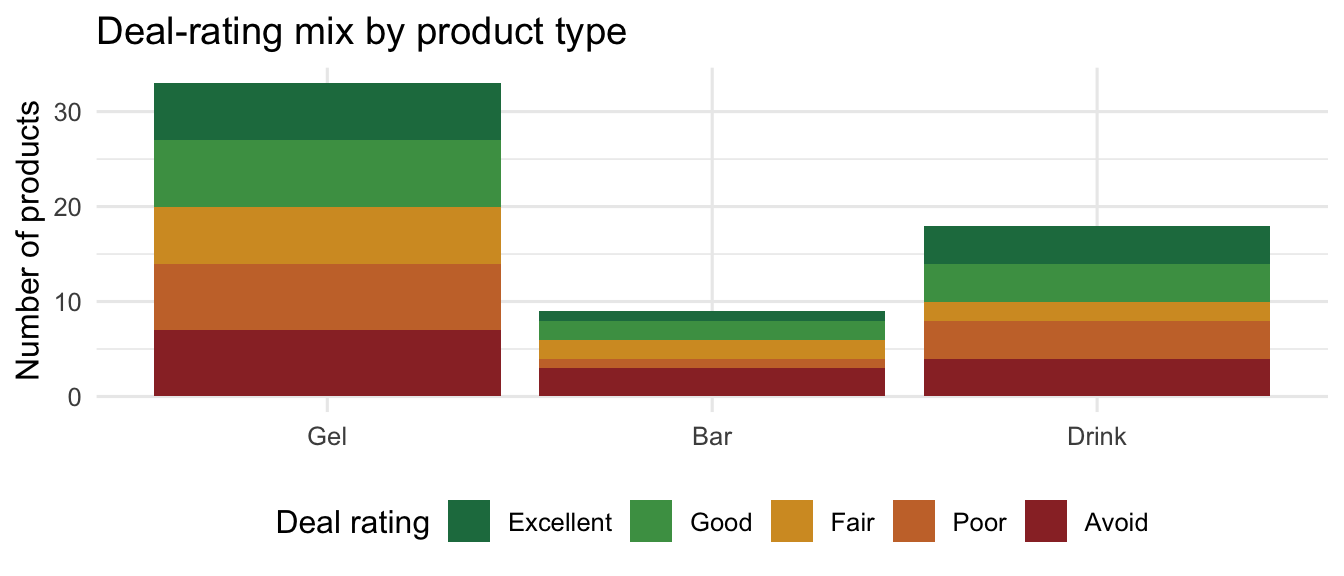
How to read it: an “Excellent” gel is in the cheapest 20 % of gels, not the cheapest 20 % of everything. That stops drink-mix tubs (which are always cheap per gram) from making every gel look “Avoid”.
Limitations
Prices, stock, specials and discount codes may influence prices here. Carbohydrate composition (glucose:fructose ratio), and sodium content of the products are not considered. The carbohydrate content of the products is based on the manufacturer’s claims, and may not be accurate. The actual vs claimed carbohydrate is not measured, nor is the amount of residual product that is left in the product packaging accounted for. We also did not account for the ease of use of the product such as gel-opening failure rates, or how long a drink mix may take to dissolve. We also did not measure how long it may take to consume a given amount of carbohydrate for each product.
Conclusion
Assuming all other things are equal, the rand per gram may be a simple way to guide purchasing decisions. Gel products are the most expensive, followed by bars and drink mixes.
Practical Applications
High value gel products should not cost more than double the rands for the amount of carbohydrate they contain. For instance, a gel that contains 30g of carbohydrate should not cost more than R60.
High value drink mix products should contain double the amount of carbohydrate per rand spent. For instance, a drink mix tub that contains 800g of carbohydrate should not cost more than R400.
Not medical advice but food for thought
There is evidence to suggest that oxidation rates of gels, bars and drink mixes do not differ when matched with liquid consumption (Jeukendrup, 2014; Pfeiffer, Stellingwerff, Zaltas, & Jeukendrup, 2010a, 2010b) and therefore the product type should be chosen based on personal preference, such as convenience or taste, instead of for “performance” reasons.
Pfeiffer, B., Stellingwerff, T., Zaltas, E., & Jeukendrup, A. E. (2010a). CHO Oxidation from a CHO Gel Compared with a Drink during Exercise. Medicine & Science in Sports & Exercise, 42(11), 2038–2045. https://doi.org/10.1249/MSS.0b013e3181e0efe6
Pfeiffer, B., Stellingwerff, T., Zaltas, E., & Jeukendrup, A. E. (2010b). Oxidation of Solid versus Liquid CHO Sources during Exercise. Medicine & Science in Sports & Exercise, 42(11), 2030–2037. https://doi.org/10.1249/MSS.0b013e3181e0efc9
Cramer, M. J., Dumke, C. L., Hailes, W. S., Cuddy, J. S., & Ruby, B. C. (2015). Postexercise Glycogen Recovery and Exercise Performance is Not Significantly Different Between Fast Food and Sport Supplements. International Journal of Sport Nutrition and Exercise Metabolism, 25(5), 448–455. https://doi.org/10.1123/ijsnem.2014-0230
Flynn, S., Rosales, A., Hailes, W., & Ruby, B. (2020). Males and females exhibit similar muscle glycogen recovery with varied recovery food sources. European Journal of Applied Physiology, 120(5), 1131–1142. https://doi.org/10.1007/s00421-020-04352-2
Trommelen, J., Fuchs, C., Beelen, M., Lenaerts, K., Jeukendrup, A., Cermak, N., & Van Loon, L. (2017). Fructose and Sucrose Intake Increase Exogenous Carbohydrate Oxidation during Exercise. Nutrients, 9(2), 167. https://doi.org/10.3390/nu9020167
Products may market natural flavoring or high quality ingredients as reasons that they are better than other products, but there is evidence to suggest that the body does not actually know the difference between food sources marketed as sports food and those that are not (Cramer, Dumke, Hailes, Cuddy, & Ruby, 2015; Flynn, Rosales, Hailes, & Ruby, 2020; Jeukendrup, 2014; Trommelen et al., 2017).
Anecdotally from this exercise, we noticed that isotonic or high sodium products (like GU Roctane, or “hydrogel” products) are much more expensive than their “normal” counterparts with the main difference being sodium content. Sodium exists in table salt and is cheap to supplement into your drink mixes based on your own needs.
Since glucose transport is saturated at 60g/hr based on the maximal transport from SGLT1, fructose is the carbohydrate type that can be increased based on increasing needs (intensity or duration) (Jeukendrup, 2014). Fructose is cheap and relatively available at pharmacies or large grocery stores. It can be supplemented into existing drink mixes based on the intensity. The more intense, the more fructose to add. For instance, a 90g CHO serving from a product marketed as a 2:1 ratio can have an additional 30g fructose added for a 120g CHO serving without saturating the SGLT1 transporter.
Jeukendrup, A. (2014). A Step Towards Personalized Sports Nutrition: Carbohydrate Intake During Exercise. Sports Medicine, 44(S1), 25–33. https://doi.org/10.1007/s40279-014-0148-z
Note: This analysis is for informational purposes only and should not be considered medical or nutritional advice. Always consult with qualified healthcare professionals before making significant changes to your nutrition or supplementation strategy.